
Custom Business Lists: Going Beyond Basic Targeting
When building a prospect list, the usual starting point is fairly straightforward: industry, job title, and location. These are the basic filters that help marketers define who they want to reach.
But sometimes, basic targeting isn’t enough.
If your campaign needs to reach a very specific audience, this is where micro-targeting can make a real difference.
Going Beyond the Basics
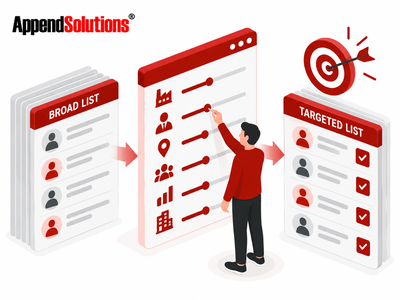
Think of a typical prospect list as casting a reasonably wide net. You may get plenty of contacts, but not every one of them will be a strong fit for your campaign.
Micro-targeting takes the process a step further by looking at the finer details that are often overlooked.
Depending on the campaign, this could include:
- Company employee size
- Annual revenue
- Specific business locations
- Location type or number of locations
- More precise job functions and seniority
- Industry sub-segments
- Other company-specific characteristics
The idea isn’t necessarily to build the biggest list possible. It’s about building a list where more of the contacts actually fit the campaign objective.
Bigger List or Better List?
This is where things can get interesting.
A larger prospect list naturally gives your sales team more contacts to work with. But a higher volume doesn’t always translate into better results. If a significant portion of those contacts aren’t relevant, your team ends up spending more time filtering, qualifying, and chasing prospects that were never a strong fit.
A smaller, highly targeted list can sometimes be much more effective.
When the audience is clearly defined, marketers can also move away from generic mass outreach and create more personalized campaigns. Instead of sending the same message to thousands of contacts, you can tailor your communication around the specific needs of a much narrower audience.
That can make a considerable difference in engagement.
Micro-Targeting Doesn’t Mean Sacrificing Scale
There is, of course, a balance to find.
Not every campaign needs highly granular targeting. If the objective is broad awareness or generating a large pool of potential prospects, conventional targeting may be perfectly suitable.
But when you’re working with a limited campaign budget, a niche product, a specialized service, or a highly specific buyer profile, precision becomes much more important.
In those situations, quality can be far more valuable than simply adding more names to a spreadsheet.
The right question isn’t always, “How many prospects can we reach?”
Sometimes it’s, “How many of these prospects are genuinely worth reaching?”
Building Lists Around Your Objective
A good custom business list should start with the campaign objective rather than a standard set of filters.
For one campaign, that might mean identifying senior decision-makers at large manufacturing companies. For another, it could mean finding specific departments within mid-sized businesses operating in a particular region.
The more clearly the audience is defined, the more precisely the list can be built.
At AppendSolutions®, we use multi-level targeting to create custom prospect lists based on the specific requirements of each campaign. This allows businesses to go beyond basic industry, title, and location filters and build lists around the characteristics that actually matter to their outreach.
The resulting data is also put through multiple levels of verification before delivery, helping clients work with cleaner and more reliable prospect data.
The Bottom Line
There is nothing wrong with building a large prospect list. But bigger doesn’t automatically mean better.
When the goal is to reach a very specific audience, micro-targeting can turn a broad prospecting exercise into a much more focused one.
The result may be fewer contacts—but contacts that are more relevant, easier to personalize for, and potentially more valuable to your sales team.
In B2B marketing, sometimes the best list isn’t the one with the most prospects.
It’s the one with the least wasted prospects.


Leave a Reply